

STAINLESS STEEL TAILPIPES
automated robotic sanding
ROI < 2 YEARS
50%Lower Personnel Costs
70% Abrasive Material Saving
24/7 Industrial Grinding Cell
Problem & Definition
HIGH QUANTITIES
- sanding weld seams
- manual work takes too long
- complicated geometry (elliptical)
- generate structure-free surface pattern
- prepare for surface polishing
Material: Stainless Steel
THE SOLUTION ACTIVE BELT GRINDER
A customized automation solution for high-quality manufacturing based on Active Compliant Tech-nology. The belt grinder delivers the following benefits:
- consistent high quality
- tolerance compensation
- easy job modulation
INITIAL SITUATION
ATJ Automotive GmbH has been a manufacturer of stainless steel sports exhaust systems for passenger cars since 1992. Many manual operations have already been automated, but when it comes to sanding the weld seams on the tailpipe, the so-called "tulip", there has been no solution until now. This is a crucial work step that has a significant impact on quality. Formed tube whose inner and outer edges have to be ground. The increase in the number of pieces made automation attractive. An urgently needed short "cycle time" for the ordered quantity and the quality required by the customer could not be achieved with conventional manual work. So, together with FerRobotics and a system integrator, a robot-assisted sanding system was developed.
THE PROCESS
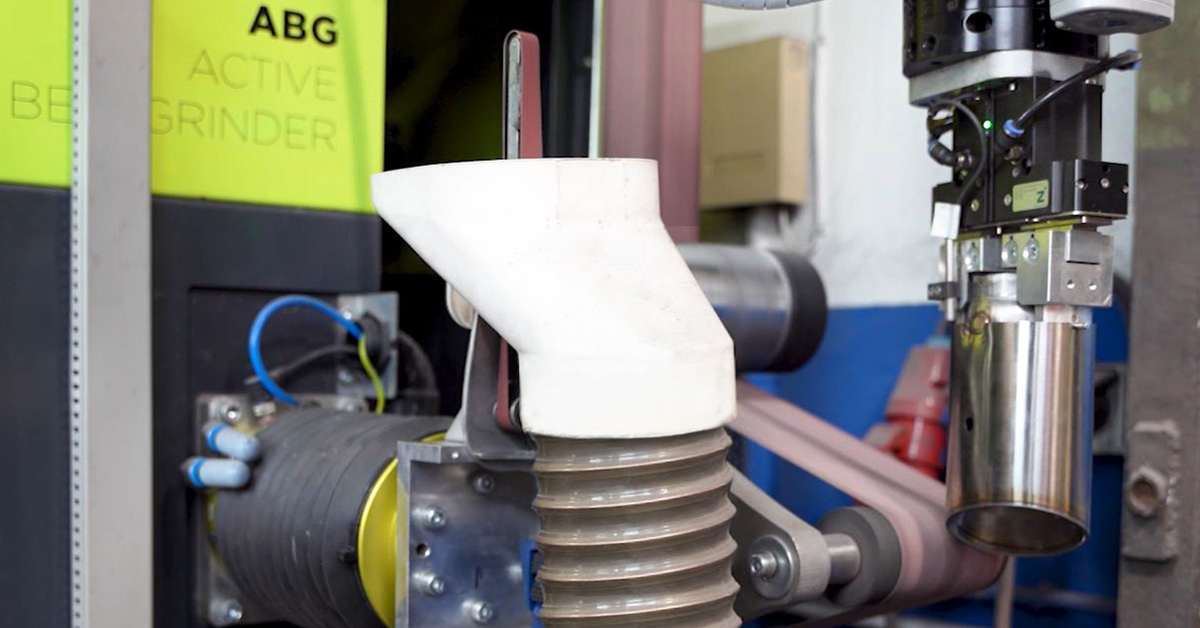
Together with FerRobotics, a Part-To-Tool solution was developed. In this robotic cell, there is a cobot which, in the first work step, grips manually provided end pipes and guides them to the ACF with beltfile attachment. Here, the inner edge of the double pipe is ground. The second step is the sanding of the outer edge of the shaped pipe, which is done by the ABG belt grinder. In both cases the shape of an ellipse is the big challenge. However, the automatic tolerance compensation creates the necessary, structure-free surface pattern, which is later required for the perfect finish - the polishing of the edges without reworking.
THE AUTOMATIZATION
It would not work without the Active Compliant Technology from FerRobotics. ATJ previously used a force/torque sensor, but it was too rigid and too slow, so the cobot produced a poor sanding pattern or kept stopping. Overall, ATJ was able to significantly speed up the process by switching to automated belt grinding technology with ACT and reduced non-productive time. Cycle time is less than one minute instead of the previous 4-5 minutes of manual labor. And manufacturing capacity is now less dependent on the availability of individual employees. Another positive effect of the use of robots is the reduced consumption of abrasives. Due to the real constant contact force during automated grinding, significantly less consumable material is required than with manual grinding.
THE RESULT
- Solution for saving personnel
- High-quality surfaces and reproducible quality
- Reduction of abrasives needed


